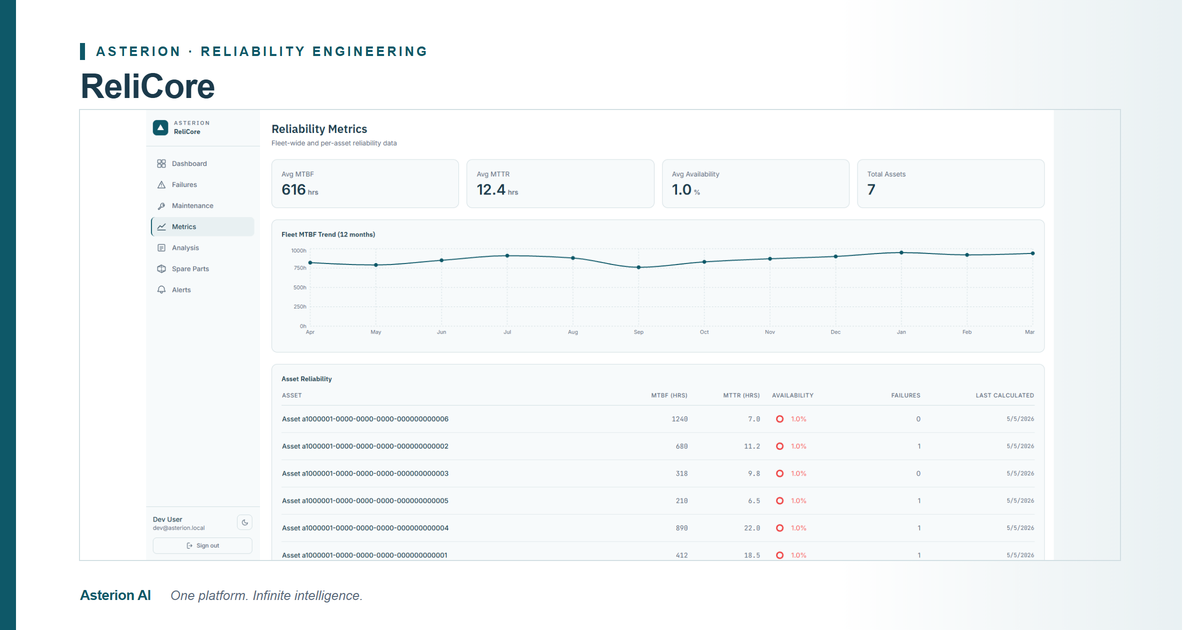
Predictive maintenance and failure analytics to reduce unplanned downtime — turning historical maintenance data into forward-looking operational intelligence.
Unplanned equipment failures combine direct repair costs with production losses, safety risk, and regulatory exposure — making them among the most destructive operational events in industrial settings. Most organisations manage reliability reactively. Without the analytics to predict failure or rank assets by criticality, maintenance resources are misallocated and risk accumulates silently.
Structured logging and categorisation of all failure events — building the historical foundation for every predictive model.
Guided RCA workflows that convert failure events into verified causal chains and actionable corrective strategies.
Configurable FMEA databases linked to asset types, operating contexts, and historical failure data across the enterprise.
Statistical modelling of Mean Time Between Failures using Weibull analysis and lifecycle degradation curves.
AI-driven maintenance recommendations — moving from reactive or time-based strategies to condition-based predictive models.
Reliability-Centred Maintenance analysis that aligns maintenance plans with asset criticality and failure consequence.
Every engagement begins with a sector-specific diagnostic — ensuring the foundation of your reliability programme is built on validated data and operational context.
Evaluation Criteria for RCM Processes
Guide to the RCM Standard
Reliability & Maintenance Data Collection
Dependability Management
Risk-Based Inspection
Risk-Based Inspection Methodology
Asset criticality and lifecycle data from AssetVault feed directly into reliability scoring and failure mode modelling — ensuring predictions are grounded in verified asset records.
Failure predictions and maintenance priority outputs from ReliCore inform shutdown scope definition in TurnSure — aligning turnaround planning with live risk intelligence.
Inspection findings and defect records from Inspecta update ReliCore's failure mode libraries automatically — keeping predictive models continuously calibrated to real-world asset condition.
Manages failure mode libraries, runs predictive models, and reviews RCM strategy outputs.
Uses predictive outputs and criticality data to schedule work orders and allocate resources.
Monitors equipment availability and receives early warning alerts for high-risk failure scenarios.
Tracks long-range reliability trends and uses data to inform capital investment and replacement decisions.
Every ReliCore engagement begins with a structured reliability assessment — analysing your failure history, maintenance strategies, and asset criticality to establish a clear performance baseline.
Diagnostics calibrated to your industry, asset types, and operational environment.
Immediate visibility into your highest-risk failure modes and maintenance gaps.
A defined deployment plan from Day 1 — no ambiguity, no wasted time.
 RELICORE · RELIABILITY ENGINEERING