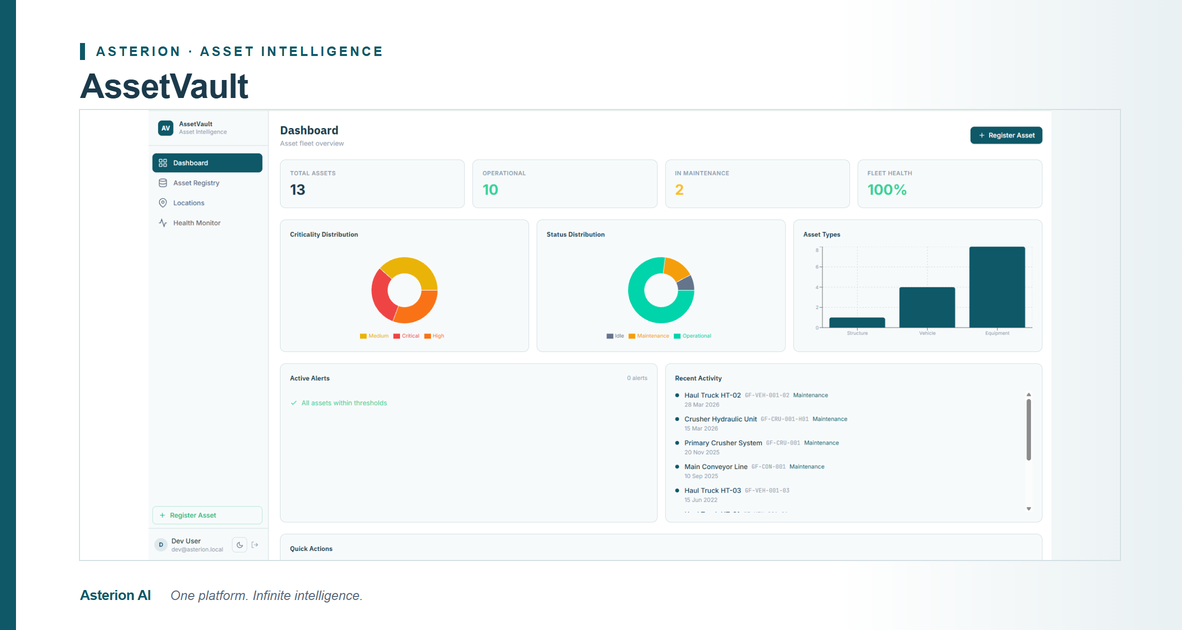
Single source of truth for all physical assets — register, hierarchy, lifecycle, and documentation unified in one operational environment.
Asset data is scattered across ERP systems, spreadsheets, CMMS platforms, and engineering drawings. No single team holds a complete picture of what assets exist, where they sit in their lifecycle, or what maintenance strategy applies.
Incomplete visibility leads to deferred decisions and capital estimation errors.
Fragmented documentation exposes the organisation to audit and regulatory risk.
Without lifecycle clarity, assets are replaced prematurely or run to failure.
Centralised digital register of all physical assets — with unique identifiers, classifications, and location mapping across every site.
Multi-level asset hierarchy from enterprise down to component level — supporting functional, location-based, and financial views.
Complete lifecycle stage management from commissioning through to decommissioning — with configurable stage gates and approval workflows.
Risk-based asset criticality assessment using configurable matrices — driving maintenance priority, inspection frequency, and investment decisions.
Engineering drawings, certificates, datasheets, and compliance documents linked directly to assets — always current, always accessible.
Long-range asset replacement and refurbishment forecasting — driven by condition, criticality, and lifecycle data.
Asset Management Overview, Principles, Terminology
Asset Management System Requirements
Guidelines for the Application of ISO 55001
Publicly Available Specification for Asset Management
Reliability & Maintenance Data Collection
Risk-Based Inspection Methodology
AssetVault is the foundational data layer for the entire Asterion Industrial Intelligence Platform. Asset data doesn't live in isolation — it drives every downstream module.
Reliability analytics draw on asset criticality and lifecycle data for accurate failure modelling and RCM strategies.
Asset register automatically drives inspection schedules and compliance requirements — eliminating manual scheduling.
Asset hierarchy and documentation feed directly into shutdown scope planning for turnaround execution precision.
Maintains the registry and monitors lifecycle status across all operational sites.
Uses criticality scores and lifecycle data to build maintenance strategies aligned with operational risk.
Manages engineering documentation and ensures technical records are linked to the correct assets.
Accesses capital planning forecasts and asset replacement schedules for long-range budget planning.
Every AssetVault engagement begins with an asset data diagnostic — a structured review of your current asset register completeness, data quality, and lifecycle visibility.
Your first step is understanding what you have. We'll show you what it means — and what it's costing you to leave it unmanaged.
Assessments calibrated to your industry, asset types, and operational environment.
Immediate visibility into your asset register completeness and data quality gaps.
A defined deployment plan from Day 1 — no ambiguity, no wasted time.
 ASSETVAULT · ASSET LIFECYCLE MANAGEMENT